Page 5 - Plant Life in Qatar
P. 5
Soils and Landform in Qatar
Qatar is basically a flat land with slight undulation and a tilt from the west (Jebal Dukhan) towards the east. Any land feature that
exceeds 60-70 m in height is referred to as a jabal (Ar. for hill/mountain). The land rises to a maximum of 103 m only at one point
south of Sudanatheel known as Taur Al Humair and is below surface at 6 m at Khor Al Udeid i.e. a total span of 109 m. Qatar’s
mainland is mainly a stony desert with depressions of varying sizes and areas of rocky outcrops.
Generally the landform includes jabal formations, sand dunes and sabkhas which together contribute to about 15% of the mainland.
Meanwhile, the main soil type [stony fragments impregnated with wind-blown sands and rocky outcrops] forms over 85% of the
mainland.
Natural vegetation is sparse and confined to specific landforms. Most of the year round few trees and shrubs exist in depressions,
along runnels and wadis. There are 10 trees in Qatar: Prosopis cineraria, Acacia ehrenbergiana, Acacia tortilis, Acacia nilotica
subsp. Indica, Ziziphus numularia, Ziziphus spina-christi, Cocculus pendulus, Ephera foliata, the mangrove Avicenia marina and
the naturalized invasive species Prosopis juliflora.
Beside trees, a number of shrubs and undershrubs occur in Qatar. Lycium shawii is the most common shrub in Qatar and Tetraena
qatarense is the most common undershrub in Qatar. It covers large areas of the mainland of Qatar and exists on all soil types. It is
the most common on vegetated areas of the stony desert. Other woody species include Ochradenus baccatus, Salsola imbricata
and Heliotropium bacciferum all dominating on disturbed locations and by roadsides everywhere in Qatar.
Along the coastline where soil salinity is high, members of the chenopods dominate. These include Halopeplis perfoliata, Suaeda
vermiculata, Suaeda aegyptiaca, Arthrocnemum macrostachyum, and Halocnemum strobilaceum. Limonium axillare, a member
of the family Plumbaginaceae occurs on saline-shelly coastal soils.
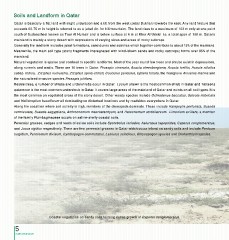
Perennial grasses, sedges and reeds of saline soils include Sporobolus ioclados, Aeluropus lagopoides, Cyperus conglomeratus,
and Jucus rigidus respectively. There are few perennial grasses in Qatar which occur inland on sandy soils and include Panicum
turgidum, Pennisetum divisum, Cymbopogon commutatus, Lasiurus scindicus, Chrysopogon species and Dichanthium species.
Coastal vegetation on sandy soils forming dense growth of Cyperus conglomeratus.
5
PLANT LIFE IN QATAR